rare, ugly, funny, strange, amazing and beautiful aviation things
Sunday, 31 January 2016
Tuesday, 26 January 2016
USAAF Hurricanes & Spitfires
The USAAF did operate a few of Britain's finest fighters...
![]() |
The USAAF used a number of Hawker Hurricane Mk.II`s as unit hacks in
the Middle East and the Airacobra equipped 350 Fighter Group even
converted some of theirs into 2 seaters
|
![]() |
| The American Hawker Hurricane with a bite! |
| Spitfire PR.XI PA944 Reconnaissance aircraft |
Sunday, 24 January 2016
Messerschmitt Me 264 'The Amerika Bomber'
The Messerschmitt Me 264 'The Amerika Bomber' was a long-range strategic bomber for the Luftwaffe that would be capable of striking the United States from Germany, a distance of about 5,800 km (3,600 mi). The concept was raised as early as 1938. Only 3 were built and the first aircraft flew on the 23th December 1942. The project was cancelled in September 1944 to allow Messerschmitt to concentrate on other aircraft production.
Read more @: http://www.luft46.com/prototyp/me264.html
Wednesday, 20 January 2016
Hurel-Dubios HD.31/32/34
![]() |
| HD.34 Photo by Han de Ridder |
The Hurel-Dubios HD.31/32/34 were a family of 11 built high aspect ratio designed aircraft.
It first flew (HD.31) on the 27th January 1953. Air France placed an order for 24 feederliners, Aigle Azur signed for four & Institut Géographique National also ordered four. In the end only the IGN aircraft were delivered for aerial photography. The aircraft's wing design made it ideal for long-duration, low-speed flight, ideal for aerial photography and survey work. These machines were designated HD.34 and were fitted with an extensively glazed nose and an offset retractable nosewheel.
Variants:
HD.31 - prototype with Wright Cyclone C7BA1 radial engines with twin fins (one built).
HD.32 - prototype with Pratt & Whitney R-1830 radial engines with twin fins (two built)
HD.321 - prototype with Wright Cyclone 982 engines and single fin. (two converted from HD.32 by replacing twin fins with a single central and two small auxiliary fins)
HD.34 - aerial survey version for IGN. Glazed nose, retractable offset nosewheel (all other aircraft had fixed, faired tricycle undercarriage). Also built with a single central and two small auxiliary fins (eight built)
Specifications: HD.34
General characteristics
Crew: Five
Length: 23.57 m (77 ft 4 in)
Wingspan: 45.30 m (148 ft 7 in)
Wing area: 100.0 m2 (1,076 ft2)
Empty weight: 12,300 kg (27,060 lb)
Gross weight: 18,600 kg (40,920 lb)
Powerplant: 2 × Wright Cyclone 982-C9-HE2, 1,140 kW (1,525 hp) each
Performance:
Maximum speed: 280 km/h (175 mph)
Range: 2,200 km (1,375 miles)
Service ceiling: 8,000 m (26,200 ft)
![]() |
| HD.34s |
![]() |
| HD.34 |
![]() |
| HD.31 Photo by Terence Wong-Lane |
![]() |
| HD.34 |
![]() |
| HD.34 Photo by Han de Ridder...Nosewheel up! |
Tuesday, 19 January 2016
Savoia-Marchetti S.55
The Savoia-Marchetti S.55 first flew in August 1924. I was very surprised that over 240 were built as I have not seen much about this aircraft in the past. The final one was retired in 1945. Only one survives today in a museum in Brazil.
The twin hulls could accommodate cargo or up to 10 passengers. The cockpit was placed in the thick wing section between the two hulls. Odd as it was the S.55 set many records for the time and was a pioneering aircraft at flights across the Atlantic when it was a very risky adventure.
In 1933 Italian Air Marshall Italo Baldo organized a squadron of 24 S.55s to attend Chicago's Century of Progress taking just over 48 hours in V formation. Now that must of been a great sight and sound! The aircraft were use by Italy's Regia Aeronautica as long-range bomber and patrol aircraft up until WWII. S.55s also operated with Aeroflot and the Military of Brazil, Spain & Romania.
Variants
S.55-Prototypes and original production model delivered from 1927 to 1930, 90 built, including two prototypes.
S.55C-Civil variant delivered from 1925 to 1926, eight built.
S.55P-Improved civil variant with enlarged hull for 10 passengers and enclosed cockpits delivered from 1928 to 1932, 23 built.
S.55A-Military variant delivered with 418 kW (560 hp) Fiat A.22R engines, 16 built.
S.55M-Variant with some wood structures replaced by metal, seven built by Piaggio in 1930.
S.55 Scafo Allargato-Widened and deepened hull and enclosed cockpits, 16 built by Savoia-Marchetti and 16 built by CANT.
S.55 Scafo Allargatissimo-Variant with greatly enlarged hull, 20 built by Savoia-Marchetti, 16 built by Macchi and six built by CANT.
S.55X-Variant fitted with Isotta-Fraschini Asso 750 engines for North Atlantic formation flights, later armed and used as a reconnaissance-bomber. 25 built.
Specifications:
MODEL: S.55X
CREW: 5-6
ENGINES: 2 x Isotta-Fraschini "Asso 750R", 656kW
WEIGHTS:
Take-off weight 8260 kg /18210 lb
Loaded weight 5750 kg /12677 lb
DIMENSIONS:
Wingspan 24.0 m/79 ft 9 in
Length 16.75 m/55 ft 11 in
Height 5.0 m/16 ft 5 in
Wing area 93.0 m2/1001.04 sq ft
PERFORMANCE:
Max. speed 279 km/h./173 mph
Cruise speed 233 km/h./145 mph
Ceiling 5000 m 16400 ft
Range w/max.fuel 4500 km/2796 miles
Range w/max.payload 2000 km/1243 miles
ARMAMENTS:
4 x 7.7mm machine-guns, 1 torpedo or 2000kg of bombs
Friday, 8 January 2016
Armstrong Whitworth Whitley
"I am not being seen in this ugly beast. I'm off!"
https://en.wikipedia.org/wiki/Armstrong_Whitworth_Whitley
Tuesday, 22 December 2015
The Blackburn Beverly
I have fond memories of the Blackburn Beverly from when I went inside one as a young teenager at RAF Hendon. This aircraft was sadly scrapped in 1981. I still remember being overwhelmed by the size of it plus the smell of it inside.
The first flight was on the 20th June 1950 (then called the GAL60) this aircraft then evolved into what we know as the Beverly today. A total of 47 were made and only one aircraft survives today at Paull near Hull. They served the RAF well around the world from 1956-67 as a heavy load, short field, dropping aircraft
See more about this wonderful brute @:
Sunday, 20 December 2015
Arado Ar 232
The Arado Ar 232 (German: "Millipede"), sometimes also called Tatzelwurm, was one of the first truly modern cargo aircraft, designed and built in small numbers by the German firm Arado Flugzeugwerke during World War II. The design introduced, or brought together, almost all of the features now considered to be "standard" in modern cargo transport aircraft designs, including a box-like fuselage slung beneath a high wing; a rear loading ramp (that had first appeared on the December 1939-flown Junkers Ju 90 V5 fifth prototype four-engined transport via its Trapoklappe); a high tail for easy access to the hold; and various features for operating from rough fields. Although the Luftwaffe was interested in replacing or supplementing its fleet of outdated Junkers Ju 52/3m transports, it had an abundance of types in production at the time and did not purchase large numbers of the Ar 232
The Ar 232 design resulted from a tender offered by the Reichsluftfahrtministerium (German Air Ministry, RLM) in late 1939 for a replacement for the Ju 52/3m transport. Both Arado and Henschel were asked for rear-loading designs powered by two 1,193 kW (1,600 hp) BMW 801A/B radial engines, which was just entering prototype production and not currently used on any front-line designs. The Arado design beat out Henschel's after an examination of the plans, and an order for three prototypes was placed in 1940.
Wilhelm van Nes led the design of the Ar 232. He began at the cargo area, with a bay directly behind the "stepless cockpit" that was 6.6 m (21 ft 7¾ in) long, 2.3 m (7 ft 6½ in) wide and 2.0 m (6 ft 6¾ in) high. Typical designs of the era would use a side-mounted door for access, but the Ar 232 used hydraulically powered clamshell-doors on the rear of the bay with a ramp to allow cargo to be rolled into the hold. The tail control surfaces were mounted on the end of a long boom to keep the area behind the doors clear so trucks could drive right up to the ramp, much like the 1944-era American Fairchild C-82 Packet of a differing twin boom fuselage configuration. The high-set tail on its "pod-and-boom" configuration fuselage allowed the Ar 232 to be loaded and unloaded faster than other designs.
For short-field performance, the Ar 232 incorporated Arado's own "travelling flap" design for the entire rear surface of the wing. Even loaded to 16,000 kg (35,270 lb), it could take-off in 200 m (656 ft). This distance could be further reduced by using rocket assist (RATO) for take-off, and either parachutes or reverse RATO for landing.
The most noticeable feature of the Ar 232 was the landing gear. Normal operations from prepared runways used a tricycle gear, but the struts could "break", or kneel, after landing to place the fuselage closer to the ground and thereby reduce the ramp angle. An additional set of ten or eleven smaller, non-retractable twinned wheels per side supported the aircraft once the main landing gear's lever-action lower oleo-strut suspended arm - carrying the main gear's wheel/tire unit - was "broken", or could be used for additional support when landing on soft or rough airfields. The aircraft was intended to be capable of taxiing at low speeds on its row of small wheels, thus being able to negotiate small obstacles such as ditches up to 1.5 m (5 ft) in width. The appearance of the row of small wheels led to the nickname "millipede". In flight, the main legs fully retracted into the engine nacelles, while the fixed support wheels remained exposed and the nose wheel only semi-retracted.
Normally operated by a crew of four, the pilot was the only member without two roles. The navigator operated a 13 mm (.51 in) MG 131 machine gun in the nose, the radio operator a 20 mm MG 151 cannon in a rotating turret on the roof, and the loadmaster a 13 mm (.51 in) MG 131 machine gun firing rearward from the extreme rear of the cargo bay above the cargo doors
Even before the prototypes were complete in 1941, the Focke-Wulf Fw 190 project had been earmarked to use the BMW 801A/B, and was proving to be a capable design. Production of the BMW 801 was insufficient to supply this new demand, and the Ar 232 was forced to use another engine. Eventually, the BMW Bramo 323 from the Junkers Ju 352 was selected instead, as it was already in production and could meet requirements if the Ar 232 really did replace the Ju 52/3m in service. The prototypes were far enough along that switching engines would have seriously delayed the program, so the first two were to be completed as the Ar 232A, and the third and a newly ordered fourth as the Ar 232B. The third and fourth prototypes (and all production aircraft) used four engines (in place of the two specified in the RLM specification) in order to provide the desired performance.
The first two prototypes, bearing the Stammkennzeichen alphabetic codes GH+GN and VD+YA respectively, started trials in early 1941. The first flight resulted in the collapse of the nose gear, but the millipede wheels saved the aircraft from damage. A further ten pre-production machines were built, and were used operationally as the Ar 232A-0 while awaiting production versions. In general, the Ar 232 completely outperformed the Ju 52/3m. It carried roughly double the load over longer distances, operated from shorter runways and rougher fields if need be, and cruised about 70 km/h (44 mph) faster.
The Ar 232B program ran at the same time. With four 895 kW (1,200 hp) Bramo 323s, power increased from 2,386 kW (3,200 hp) to 3,580 kW (4,800 hp), solving the A model's problem of having little excess power in case of engine failure. This change also required the wing to be extended slightly, the span increasing just over 3 m (9 ft 10 in) in total. The extra weight of the engines also moved the center of gravity forward, which was offset by extending the cargo area rearward another meter.
Two four-engined prototypes were ordered, the V3 and V4, and V3 first flew in May 1942. A further 10 were then ordered as the Ar 232B-0, and were used widely in an operational role. However, this was the only order for the design, as the Luftwaffe gave transport aircraft production a very low priority. Many of those produced were used by Arado to transport aircraft parts between its factories, and did not see front-line service.
Plans were also made to replace the outer wing sections and control surfaces with wooden versions to conserve aluminium. Originally to be known as the Ar 232C, the design dragged on and was later renamed the Ar 432. Plans were finally put into place to start production in October 1945, but the war ended without even a prototype being produced. Two even larger planned versions, the Ar 532 and the Ar 632, would have almost doubled the wingspan to 60 m (196 ft 10 in) and added another two engines.
Two of the B-0s were captured by British forces at the end of the war. After test flights by Eric "Winkle" Brown, who gave the design excellent marks, they were used by the Royal Air Force on flights between England and Germany after the war.
Ar 232 V1 & V2
Ar 232A prototypes and research aircraft, powered by two 1,193 kW (1,600 hp) BMW 801A/B engines.
Ar 232 V3 & V4
Ar 232B prototypes and research aircraft, powered by four BMW Bramo 323R-2 Fafnir engines.
Ar 232A
Pre-production aircraft used for operational trials, powered by two BMW801 engines, only ten built.
Ar 232B
The first production aircraft powered by four Bramo 323 Fafnir engines, only ten built as Ar 232B-0.
Ar 232C
A redesigned version using wood for outer wing sections and control surfaces.
Ar 432
The planned production version of the Ar 232C, renamed.
Ar 532
Planned enlarged six-engined version of the Ar 432.
Ar 632
Planned enlarged six-engined version of the Ar 432
Specifications (Ar 232B)
General characteristics
Crew: 4
Length: 23.52 m (77 ft 2 in)
Wingspan: 33.50 m (109 ft 10¾ in)
Height: 5.69 m (18 ft 8 in)
Wing area: 142.60 m² (1,535 ft²)
Empty weight: 12,780 kg (28,175 lb)
Max. takeoff weight: 21,150 kg (46,628 lb)
Powerplant: 4 × BMW Bramo 323R-2 Fafnir 9-cylinder radial engine, 895 kW (1,200 hp) each
Performance
Maximum speed: 308 km/h (191 mph) at 4,000 m (13,100 ft)
Cruise speed: 290 km/h (180 mph) at 2,000 m (6,560 ft)
Range: 1,062 km (660 mi)
Service ceiling: 6,900 m (22,640 ft)
Armament
Guns:
1 × 13 mm (.51 in) MG 131 machine gun mounted in the nose
1 × 20 mm MG 151 cannon mounted in an EDL 151 dorsal turret
1-2 × 13 mm (.51 in) MG 131 machine gun mounted in the rear position
8 × 7.92 mm (.312 in) MG 34 machine guns mounted in side windows when transporting infantry
From Wikipedia
Monday, 16 November 2015
Douglas DC-5
The forgotten/rare Douglas DC-5 was a 16-to-22-seat short range aircraft. It first flew on the 20th February 1939. Only 12 were built.
http://www.boeing.com/history/products/dc-5.page
Sunday, 8 November 2015
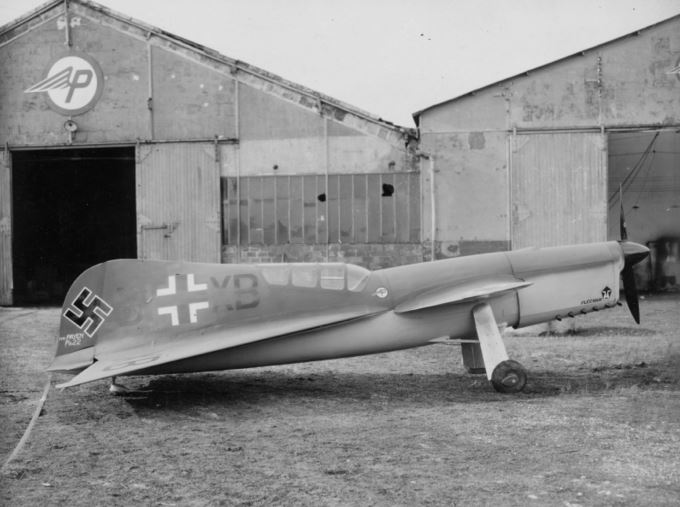
Payen PA-22/PA-112
Roland Payen evolved a radical tandem-wing configuration which he dubbed the Fléchair, the short-span tapered foreplane carrying a combination of ailerons and flaps and the 67-deg aft plane carrying combined elevator-flaps, the pilot’s cockpit fairing into the vertical tail surfaces. In 1938, Payen proposed to the Ministère de l’Air a lightweight fighter version of the PA 112, a racing aircraft then being developed by the Sociêté Co-operative d’Etudes et Productions Aéronautiques (SCEPA) to the Fléchair configuration and intended to participate in the 1939 Coupe Deutsch de la Meurthe. The PA 112 was to be a retractable monowheel undercarriage with outrigger skids retracting into the aft plane. Weighing only 948 lb (430 kg) empty and 1,345 lb (610 kg) loaded, the PA 112 had extremely small overall dimensions which included a span of 13 ft 7¾ in (4,16 m) and a length of 22 ft 1 in (6,74 m), height being 6 ft 11 in (2,11 m), and it was rather optimistically anticipated that a maximum speed of 360 mph (580 km h) would be attainable. The projected lightweight fighter derivative, the PA112 Cl, was to have had two wing-mounted 7,5-mm machine guns and a 20-mm cannon firing through the extension shafts of the Salmson engines, and an elaborate mock-up of the proposed PA112 Cl was built, this, in fact, utilising the airframe of one of the two PA 100 Coupe Deutsch racing aircraft. Possibly as a result of the dramatically unorthodox nature of the proposed PA 112 Cl, no contract was forthcoming from the Ministère de lAir.
Although no example of the PA 112 was completed and the 1939 Coupe Deutsch was destined never to take place, development of the Fléchair concept continued with the PA 22 which was of similar configuration to the PA 112 but had a conventional engine installation and a conventional fixed tailwheel under-carriage. The PA 22 had originally been built to test the Mèlot ramjet but was eventually to be completed in 1939 with a 180 hp Régnier R6 inverted inline air-cooled engine. After completion, it was mounted in the Chalais- Meudon wind tunnel where it was found by the German occupation forces who expressed some curiosity as to its possible flying characteristics. Accordingly, it was transferred to Villacoublay where it was flown for the first time by Jacques Charpentier in October 1942. A flight test programme was conducted, but before this could be completed, the German authorities decided that the PA 22 should be taken to Rechlin. However, on the pretext that a number of modifications were necessary, Payen succeeded in having the prototype returned to his factory at Juvisy where it was intended to make changes to the undercarriage, mount supplementary fuel tanks and fit a variable-pitch propeller. In the event, these modifications were still in process when the factory was hit during an Allied bombing raid on the Juvisy railway yard, the PA 22 being destroyed.
Engine: Régnier R6 inverted inline air-cooled, 180 hp
Empty weight: 1,221 lb (554 kg)
Loaded weight: 1,894 lb (859 kg)
Wing span: 15 ft 9 in (4,80 m)
Length: 24 ft 3.33 in (7,40 m)
Height: 7 ft 8½ in (2,25 m)
Wing area: 107.64 sq ft (10,00 sq.m)
Maximum speed: 224 mph (360 kmh)
Maximum cruise: 205 mph (330 kmh)
Landing speed: 47 mph (75 kmh)
Info from http://all-aero.com/
Subscribe to:
Posts (Atom)