Saturday, 16 February 2013

Liberator and Swordfish crashes at Orchard Hill Farm Dorset

Aviation follows me even when I am on holiday! I came across this on a walk near Kingston Dorset.
From the Dorset Echo...
On the morning of Friday, June 15, 1945, with the war still raging in the Far East, Liberator JT985 of No 232 Squadron took off from RAF Holmsley South in the New Forest, on the first leg of its long flight to Palam, India. The first refuelling stop was scheduled to be at RAF Castel Benito, near Tripoli in North Africa.
This Liberator was a passenger-carrying RY-3' (US designation) variant, with passenger accommodation in the former bomb bay area as well as within the main fuselage, and was distinguished easily from the twin tail fin bomber variants so well known with Coastal Command and the USAAF by its single large tail fin. It was unarmed.
The aircraft was under the command of Flt Lt Saxon Cole RCAF; other crew members were Fg Off Donald Twaddle RCAF (co-pilot), Fg Off Joseph Todd RCAF (navigator), Fg Off George McPherson RCAF (radio officer and an American citizen) and Sgt George Wyke RAF (flight engineer). The passenger load consisted not of VIPs, as was the more normal load for such a flight, but of 22 airmen being sent out as urgently needed groundcrew at Palam.
The weather at Holmsley South was poor, but both the captain and the duty executive officer considered it suitable for take-off, but poor enough for a diversion to be likely if an early return was necessitated. JT985 departed at 0720 hours.
At 0745 hours, shortly after crossing the coast outbound, the aircraft reported a loss of fuel pressure and that the crew were turning back to carry out a precautionary landing at Holmsley South. This information was repeated again 10 minutes later.
At around 0815 hours the owner of Encombe House, Sir Ernest Scott, and a worker at Encombe dairy saw the aircraft, which was obviously below the height of the hills, and both knew instinctively that it was going to crash.
It impacted on the edge of what is now the Dorset Coastal Path, the wings were ripped off and the engines detached and were thrown forward towards Orchard Hill Farm, one wing coming to rest on the footpath (not a public footpath) in Polar Wood leading from the top of the ridge to the farm. There were no survivors.
The first to reach the scene were an RAF sergeant by the name of Reginald Reynolds, who was staying at Encombe House, and members of an Army searchlight battery located between the farm and the village of Kingston; they were soon joined by RAF personnel from, presumably, nearby RAF Worth Matravers. The National Fire Service from Swanage was soon on the scene, as were local police officers.
When the low cloud lifted at about eleven o'clock a scene of total devastation was revealed.
The tragic remains of 27 bodies was joined by much in the way of personal belongings such as a baby's photograph, playing cards, personal notebooks, wallets and the like, together with a distinguished flying cross, thrown from its box but which was also retrieved.
Who did the DFC belong to? Not any of the crew or passengers, so maybe it was being taken to India for presentation to its owner?
There was also a large amount of tropical uniform items and, to the delight of the local children, tins of boiled sweets.
The bodies of the crash victims were eventually taken away to Poole Mortuary. This was, and still is, Dorset's worst ever air crash.
The crash of Liberator JT985 in June 1945 was not the only fatal aircraft accident on North Hill above Encombe.


On the afternoon of Friday, March 18, 1938, a student on the torpedo course at the Torpedo Training Unit at RAF Gosport took off at 2.15pm in a Mk 1 Swordfish K5985 on a training cross-country flight to Roborough, just north of Plymouth.
The pilot was Plt Off Frederick Edgar Williams, aged 21, his two passengers along for the ride' were Cpl Cyril John Coles, 32, and LAC David Samuel Hurrel, also 21.
Plt Off Williams had just over 200 hours in his logbook, of which 25 were on the Swordfish.
He was briefed to return to Gosport if the weather en route deteriorated, but he seems to have encountered low cloud approaching the Purbecks and tried to duck under it, passed low over Orchard Hill Farm at 2.45pm, clipped the top of the trees in Polar Wood - leaving sections of the aircraft in the tree tops - and nose-dived into the steep hillside some 300 yards away, the Bristol Pegasus engine detaching and rolling further down the valley.
All three onboard were probably killed instantly, despite the brave efforts of local man Bob Dorey, who climbed up from Encombe House to the blazing wreckage with two fire extinguishers and attempted to get close enough to the Swordfish to pull them from the inferno.
Other local folk also tried to get near to the wreckage but were beaten back by the heat of the flames.
Personnel from the Sick Bay Unit at RAF Warmwell attended the scene and had the difficult task of retrieving the three bodies and manhandling them to the top of the ridge before taking them back to base in their ambulance.
The Coroner's inquest recorded a verdict of accidental death.


Sunday, 3 February 2013

"FAB" Gerry Anderson RIP

Thunderbird 2

Thunderbird 2 (ish)


http://en.wikipedia.org/wiki/Gerry_Anderson
The Genius and inspiration of so many kids who went on to love Aviation - Gerry Anderson 14/4/29-26/12/12

The Thunderbird 2 like airship:
http://www.aeroscraft.com/

...a lovely dream. If only!


Thursday, 13 September 2012

Dunkeswell Airfield


Liberator of VB-103 taking off from Runway 23


Dunkeswell Airfield (EGTU) is an airfield in East Devon, England. It is located approximately 5 miles north of the town of Honiton. Today it is a busy civilian airfield with a mix of light aircraft, microlights and parachuting.

The airfield was opened in 1943, during the Second World War, as RAF Dunkeswell. The station was originally planned as a RAF Fighter Command, then a RAF Coastal Command airfield, but was transferred for use by American units.  Dunkeswell was unique in that it was the only British airfield where the United States Navy Fleet Air Wing was stationed in World War Two. Dunkeswell was affectionately called by the Americans “Mudville Heights”.

It was first used by the American United States Army Air Force's Antisubmarine Command, 479th Antisubmarine Group, as a base of operations to fly antisubmarine missions over the Bay of Biscay using specialized B-24 Liberator bombers from August until November 1943.

In November the United States Army Air Forces turned over the antisubmarine mission to the United States Navy and its Liberators were reassigned to Navy Patrol Bomber Squadron VPB-103, Fleet Air Wing 7, which continued aerial antisubmarine operations from the station, the AAF aircraft being redesignated under the USN/USMC system of the time as PB4Y-1 Liberators. This was the first United States Navy unit to train with the RAF, later followed by VB-105 and VB-110. The Naval antisubmarine squadrons moved to the nearby RAF Upottery in November 1944.

With the departure of the Americans, the RAF used the airfield from August 1945 to April 1946 for ferrying aircraft to the Middle East by 16 Ferry Unit, RAF Transport Command. After September 1946 the station was put on care and maintenance status until the end of 1948, when it was sold by the Ministry of Defence.

Read more about Dunkeswell @ http://www.southwestairfields.co.uk/?page_id=53


Liberator taking off from RAF Dunkeswell, January 1944. 
There were three U.S. Navy bomber squadrons stationed
 at Dunkeswell during this time period, VB-103, VB-105 and VB-110


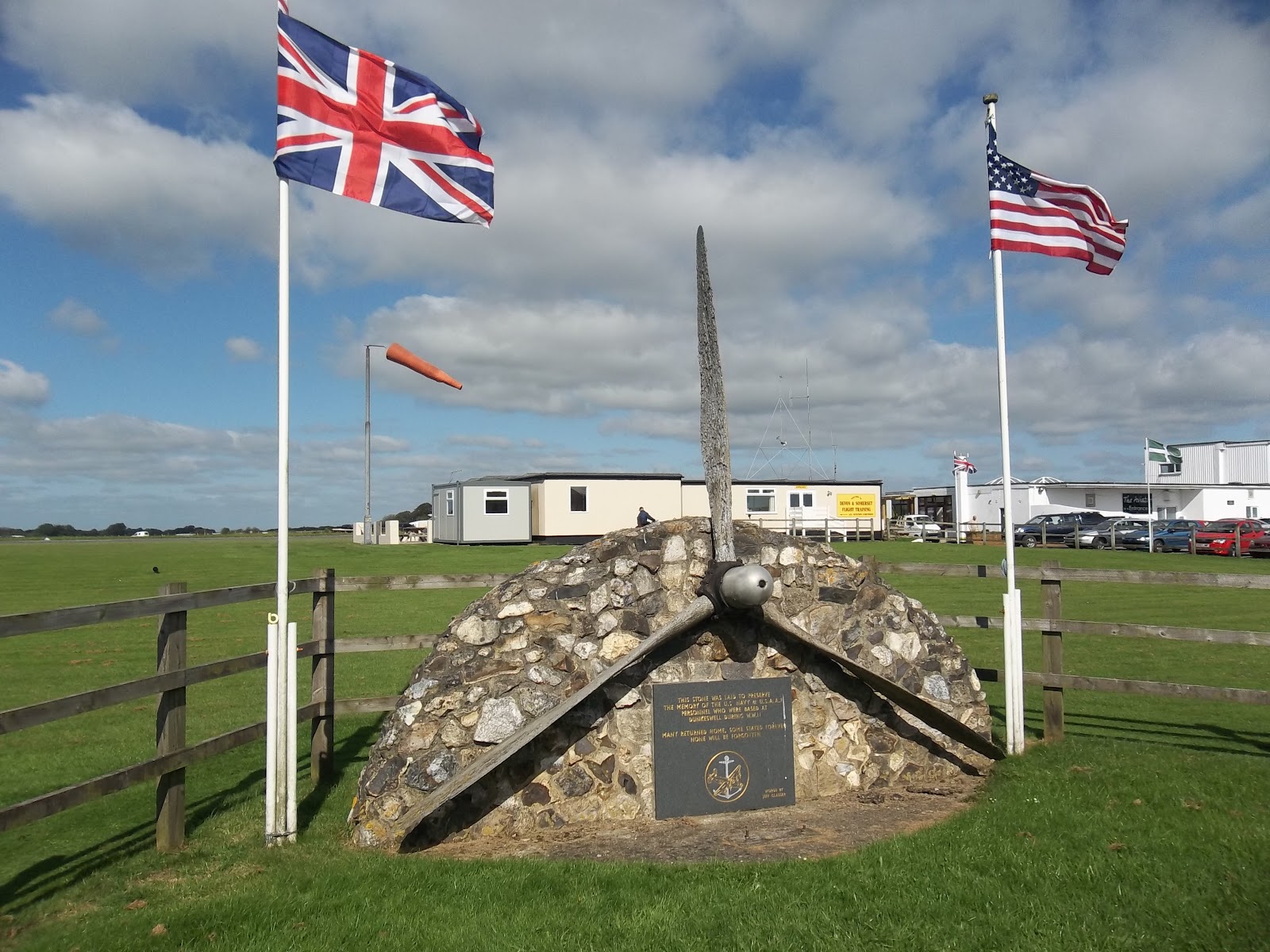
...the inscription from the memorial photo below:


A photo of runway 17 in 2012


Dunkeswell layout 2012.

Runway lenghts:
04/22 968m 3,176ft Asphalt. 17/35 644m 2,113ft Asphalt


Thursday, 30 August 2012

Piper PA-35 Pocono


The Piper PA-35 Pocono was an American 16/18 seat commuter airliner developed by the Piper in the late 1960s. Only one aircraft was built and the design was not developed

Piper started the design work in 1965 for a twin-engined piston non-pressurised commuter airliner and the prototype first flew on 13 May 1968. It was a low-wing monoplane that was intended to be powered by two 475 hp (354 kW) Lycoming TIO-720-B1A piston engines then under development. It was planned that the aircraft would be built at the new factory at Lakeland Municipal Airport in Florida. Due to problems during development the tail area was increased, the fuselage stretched and the engines uprated to 520 hp (388 kW) variants.
Development was stopped in 1969 initially to let the company develop other aircraft, but was also influenced by the lack of a suitable engine and a number of third-level airline operators in the United States going out of business. In 1970 the company proposed a four-engined and turboprop versions but they were not developed.
In about 1978 a cooperation programme between Piper and WSK Mielec (Poland) was planned. As part of this one fuselage with wings was transported from Florida to Poland and a team of designers was assembled at the R&D Center in Mielec. The programme was named M-19, with designer Tadeusz Widełka as the team leader. The programme was abandoned when the An-28 programme was launched in Mielec and the PA-35 fuselage was moved to the Technical University in Rzeszów. Later, probably in 1994, the aircraft was moved to the city of Widełka.  From Wikipedia

More reading, photos, and info here (scroll the page down a bit): 

Saturday, 14 July 2012

Wilson Global Explorer


The Wilson Global Explorer is an American-built amphibious aircraft of the early 1990s which has been utilised to assist the exploration of remote areas. The high-wing twin-engine aircraft was designed and constructed by Dean W. Wilson to the order of the explorer Hubert de Chevigny and the aircraft first flew in April 1991. A second aircraft was constructed later.

The Global Explorer has an unusually deep and wide fuselage design with many inserted glazed areas and accommodation at the rear for sleeping and other purposes. For added strength, the high-set wings are each supported by brace structures from the side fuselage and from the lower sponsons. The nose gear retracts forward of the hull and acts as a bumper for operations off water. The main wheels can be removed and the fixed side sponsons assist flotation and manoeuvring on water. Various Lycoming engines of between 200 hp and 300 hp have been fitted, depending on the expected altitude to be reached during planned operations
The Global Explorer has been used by Hubert de Chevigny, with the name "L'Avion" on its nose, in the exploration and filming of a wide variety of locations including Australia's Great Barrier Reef, Argentina's Tierra del Fuego and Bolivia. It can be readily stripped down and shipped by sea to required locations and can carry and accommodate seven persons overnight.
Wikipedia


General characteristics:
Crew: 1
Capacity: 6 passengers and crew
Length: 39 ft 10 in (12.14 m)
Wingspan: 67 ft 0 in (20.42 m)
Height: 22 ft 0 in (6.71 m)
Empty weight: 4,995 lb (2,266 kg)
Gross weight: 8,000 lb (3,629 kg)
Powerplant: 2 × Lycoming IO-540 , 300 hp (220 kW) each

Performance:
Maximum speed: 120 mph (193 km/h; 104 kn)
Cruise speed: 110 mph (96 kn; 177 km/h)
Stall speed: 60 mph (52 kn; 97 km/h)

More info @:


Saturday, 30 June 2012

Scottish European

Scottish European (WW/SEU) was set up in July 1988 acquiring the two aircraft and licences of the defunct Chieftain Airways. Ad hoc charter operations started on October 5th 1988. Scheduled services between Glasgow, Brussels and Frankfurt were launched in November 1988. Edinburgh-Brussels was opened in May 1989, followed by Edinburgh-Frankfurt in July and Newcastle-Frankfurt in September 1989. The 748s were operated in a generous 40-seat configuration, with a high level of cabin service. The company after one large injection of cash and adding a third aircraft finally ran out of steam in April 1990.

Fleet details:
G-BMFT HS.748 2A (C/N 1714)
G-BPDA HS.748 2A (C/N 1756) ex Chieftain Airways
G-BPFU HS.748 2A (C/N 1757) ex Chieftain Airways

G-BPFU HS.748 2A (C/N 1757)


Chieftain Airways (C/N 1756) G-GLAS
 that ended up as G-BPDA with Scottish European

Friday, 29 June 2012

MD-80SF Freighter

A freighter version of the MD80 series had been talked about for years. With over 200 MD80s parked up and 600+ in service it makes the conversion an attractive alternative to the 737-400 for roughly one-third of the price. Due to the non standard cargo containers AEI is targeting airlines that do not transfer cargo between types.

The first MD-80SF Freighter has now been converted by Aeronautical Engineers (AEI). This is ex American Airlines MD-82 (c/n 49470, registration N73444). Everts Air Cargo will acquire this aircraft after certification has been completed.

AEI has firm orders for fifteen MD-80SFs from four undisclosed customers. So hopefully? Mad Dogs will be around for many years with this new lease of life.

More info @
http://www.aeronautical-engineers.com/AEI%20MD80SF%20Conversion%20Progress.pdf


Below is from: http://www.flightglobal.com
Florida's Aeronautical Engineers has performed the maiden flight of its converted Boeing MD-80 freighter, and the modification specialist is optimistic of obtaining a supplemental type certificate for the aircraft by the end of the month. The passenger-to-freight converted twinjet took off on its first flight on 28 September.

"It only has to do a smoke-test flight, and has already passed its smoke test on the ground," says Robert Convey, vice-president of sales and marketing for Aeronautical Engineers."We do not have to do any flight performance tests, because we are not altering those aspects of the aircraft."

AEI says it already has 15 orders lined up for the 21t freighter, which has a similar payload and range to the Boeing 737-400, although with a smaller cross-section. Customers are based in the USA, South America, Africa, the Middle East and Europe.

The company expects to have two to three lines performing the conversions from next May, for which it ultimately predicts demand for as many as 200, mainly from carriers in developing countries.

Aeronautical Engineers, which has already performed 737 conversion work, embarked on the MD-80 programme in February 2010 and has carried out the initial development work - including installation of a class-E cargo compartment on the main deck - on a former American Airlines aircraft.
(post updated 09/10/2012)


Wednesday, 27 June 2012

Princess Air

Princess Air (Q8/PRN) was a British airline that operated 2 x BAe146s between 1998-1991 based at Southend-on-Sea Essex. Formed by local Tour operator Burstin Travel operating passenger charter flights along with cargo flights at night (using its quick change passenger to freighter BAe 146-200QC G-PRIN). Cargo flights were operated between Cologne & Brussels. Charter passenger flights operated from Southend, Bournemouth, Bristol & Exeter amongst others to destinations that included: Jersey, Faro, Malaga, Alicante, Palma, Venice, & Dubrovnik. In the end with more aircraft (200QCs) on order they stopped operating in February 1991 due to the economic climate at the time.

G-PRIN BAe 146-200QC 


Info about Princess Air
click to enlarge or download to read