Monday, 16 November 2015

Douglas DC-5

The forgotten/rare Douglas DC-5 was a 16-to-22-seat short range aircraft. It first flew on the 20th February 1939. Only 12 were built.
http://www.boeing.com/history/products/dc-5.page


Sunday, 8 November 2015

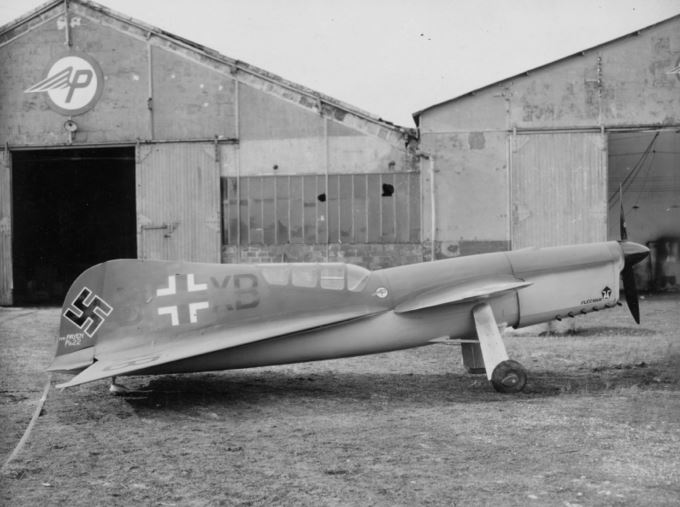
Payen PA-22/PA-112

Roland Payen evolved a radical tandem-wing configuration which he dubbed the Fléchair, the short-span tapered foreplane carrying a combination of ailerons and flaps and the 67-deg aft plane carrying combined elevator-flaps, the pilot’s cockpit fairing into the vertical tail surfaces. In 1938, Payen proposed to the Ministère de l’Air a lightweight fighter version of the PA 112, a racing aircraft then being developed by the Sociêté Co-operative d’Etudes et Productions Aéronautiques (SCEPA) to the Fléchair configuration and intended to participate in the 1939 Coupe Deutsch de la Meurthe. The PA 112 was to be a retractable monowheel undercarriage with outrigger skids retracting into the aft plane. Weighing only 948 lb (430 kg) empty and 1,345 lb (610 kg) loaded, the PA 112 had extremely small overall dimensions which included a span of 13 ft 7¾ in (4,16 m) and a length of 22 ft 1 in (6,74 m), height being 6 ft 11 in (2,11 m), and it was rather optimistically anticipated that a maximum speed of 360 mph (580 km h) would be attainable. The projected lightweight fighter derivative, the PA112 Cl, was to have had two wing-mounted 7,5-mm machine guns and a 20-mm cannon firing through the extension shafts of the Salmson engines, and an elaborate mock-up of the proposed PA112 Cl was built, this, in fact, utilising the airframe of one of the two PA 100 Coupe Deutsch racing aircraft. Possibly as a result of the dramatically unorthodox nature of the proposed PA 112 Cl, no contract was forthcoming from the Ministère de lAir.


Although no example of the PA 112 was completed and the 1939 Coupe Deutsch was destined never to take place, development of the Fléchair concept continued with the PA 22 which was of similar configuration to the PA 112 but had a conventional engine installation and a conventional fixed tailwheel under-carriage. The PA 22 had originally been built to test the Mèlot ramjet but was eventually to be completed in 1939 with a 180 hp Régnier R6 inverted inline air-cooled engine. After completion, it was mounted in the Chalais- Meudon wind tunnel where it was found by the German occupation forces who expressed some curiosity as to its possible flying characteristics. Accordingly, it was transferred to Villacoublay where it was flown for the first time by Jacques Charpentier in October 1942. A flight test programme was conducted, but before this could be completed, the German authorities decided that the PA 22 should be taken to Rechlin. However, on the pretext that a number of modifications were necessary, Payen succeeded in having the prototype returned to his factory at Juvisy where it was intended to make changes to the undercarriage, mount supplementary fuel tanks and fit a variable-pitch propeller. In the event, these modifications were still in process when the factory was hit during an Allied bombing raid on the Juvisy railway yard, the PA 22 being destroyed.

Engine: Régnier R6 inverted inline air-cooled, 180 hp
Empty weight: 1,221 lb (554 kg)
Loaded weight: 1,894 lb (859 kg)
Wing span: 15 ft 9 in (4,80 m)
Length: 24 ft 3.33  in (7,40 m)
Height: 7 ft 8½  in (2,25 m)
Wing area: 107.64 sq ft (10,00 sq.m)
Maximum speed: 224 mph (360 kmh)
Maximum cruise: 205 mph (330 kmh)

Landing speed: 47 mph (75 kmh)

Info from http://all-aero.com/


Tuesday, 13 October 2015

The DH.91 Albatross. One of the most beautiful British airliners ever built.

Frobisher


The aircraft was remarkable for the ply-balsa-ply sandwich construction of its fuselage which was later made famous in the de Havilland Mosquito bomber. Another unique feature was a cooling system for the air-cooled engines that allowed for nearly ideal streamlining of the engine mounting. The first Albatross flew on May 20, 1937. The second prototype broke in two during overload tests but was rebuilt and it and the first prototype were used by Imperial Airways.

Although designed as a mailplane, a version to carry 22 passengers was developed; the main differences were extra windows and the replacement of split flaps with slotted flaps. Five of these made up the production order delivered in 1938/1939.

Operational history:
As normal for the Imperial Airways fleet of the time, all were given names starting with the same letter, and the first aircraft's name was also used as a generic description for the type overall, as "Frobisher Class". This tradition, which came from a maritime and railway background of classes of ships and locomotives, lasted well into post-war days with BOAC and BEA.

The first delivery to Imperial Airways was the 22-passenger DH.91 Frobisher in October 1938. The five passenger carrying aircraft were operated on routes from Croydon to Paris, Brussels and Zurich. After test flying was completed the two prototypes were delivered to Imperial Airways as long-range mail-carriers. The only significant season of their operation was the summer of 1939, when they were the main type on the two-hourly London Croydon to Paris Le Bourget passenger route.

With the onset of World War II, the Royal Air Force considered their range and speed useful for courier flights between Great Britain and Iceland and the two mailplanes were pressed into service with 271 Squadron in September 1940. Both aircraft were destroyed in landing accidents in Reykjavík: Faraday in 1941 and Franklin in 1942.

The five passenger aircraft were used by Imperial Airways, (BOAC from September 1940) on Bristol-Lisbon and Bristol-Shannon routes from Bristol (Whitchurch) Airport. One aircraft Frobisher was destroyed during a German air raid on Bristol in 1940, One (Fingal) was destroyed in a crash landing following a fuel pipe failure in 1940 at Pucklechurch, while Fortuna crashed near Shannon Airport in 1943. This accident was found to be due to deterioration of the aircraft's plywood wing structures. The two surviving aircraft were found to have similar problems and so Falcon and Fiona were scrapped in September 1943.

Aircraft:

Faraday
Mail carrier variant was delivered to Imperial Airways in August 1939 as Faraday and registered G-AEVV. It was transferred to BOAC when it was formed in 1940 but was impressed into Royal Air Force service with serial number AX903 for operation by No. 271 Squadron RAF. It was destroyed in a landing accident at Reykjavik on the 11 August 1941.

Franklin
Mail carrier variant was delivered to BOAC as Franklin and registered G-AEVW. Impressed into Royal Air Force Service with the serial number AX904 for operation by 271 Squadron. It was destroyed when the landing gear collapsed on landing at Reykjavik on the 7 April 1942.

Frobisher
Passenger variant was registered G-AFDI and delivered to Imperial Airways (later BOAC) as Frobisher in 1938. It was destroyed on the ground during a German air attack on Whitchurch Airport on 20 December 1940.

Falcon
Passenger variant was registered G-AFDJ and delivered to Imperial Airways (later BOAC) as Falcon in 1938. It was scrapped in September 1943.

Fortuna
Passenger variant was registered G-AFDK and delivered to Imperial Airways (later BOAC) as Fortuna in 1939. Destroyed in a crash landing near Shannon Airport, Ireland on 16 July 1943.

Fingal
Passenger variant was registered G-AFDL and delivered to Imperial Airways (later BOAC) as Fingal in 1939. Destroyed in a crash landing near Pucklechurch, Gloucestershire, England on 6 October 1940.

Fiona
Passenger variant was registered G-AFDM and delivered to Imperial Airways (later BOAC) as Fiona in 1939. It was scrapped in September 1943.

Operators;
Imperial Airways which was reorganized as British Overseas Airways Corporation received all seven aircraft.
Royal Air Force
No. 271 Squadron RAF operated two aircraft taken over from BOAC.

Specifications:
Data from British Civil Aircraft since 1919

General characteristics
Crew: 4 (pilot, copilot, radio operator and steward)
Capacity: 22 passengers
Length: 71 ft 6 in (21.80 m)
Wingspan: 105 ft 0 in (32.01 m)
Height: 22 ft 3 in (6.78 m)
Wing area: 1,078 ft² (100.2 m²)
Empty weight: 21,230 lb (9,650 kg)
Loaded weight: 29,500 lb (13,380 kg)
Powerplant: 4 × de Havilland Gipsy Twelve 12-cylinder inverted V piston engine, 525 hp (392 kW) each

Performance
Maximum speed: 195 kn (225 mph, 362 km/h)
Cruise speed: 183 kn (210 mph, 338 km/h)
Range: 904 nmi, (1,040 mi, 1,675 km)
Service ceiling: 17,900 ft (5,455 m)
Rate of climb: 700 ft/min (3.5 m/s)
Wing loading: 27 lb/ft² (134 kg/m²)
Power/mass: 0.07 hp/lb (120 W/kg)

From Wikipedia

Albatross youtube clip


Monday, 12 October 2015

Blohm & Voss BV 141


Blohm & Voss BV 141 looked very odd  but it never saw operational service. Three prototypes of the BV 141 were made, before it went into limited production of just 23

Crew: 3, pilot, observer and rear-gunner.
Length: 45 ft 9 in
Wingspan: 45 ft 9 in
Height: 11 ft 9 in
Wing area: 570 ft²
Empty weight: 10,363 lb
Loaded weight: 12,568 lb
Powerplant: 1× BMW 801 
radial piston, 1,560 hp

Performance:Maximum speed: 272 mph at 
11,500 ft
Range: 745 mi
Service ceiling: 32,800 ft
Rate of climb: 1,860 ft/min
Wing loading: 12.3 lb/ft²
Power/mass: 0.274 hp/lb

Armament:Guns: 2 × 7.92 mm MG 17 
machine guns and 2 × 7.92 mm 
MG 15 machine guns


Blohm & Voss BV 141 Wikipedia

Blohm and Voss BV 141 - rare film


Edgley EA-7 Optica


http://www.optica.co.uk/index2.html


Sunday, 4 October 2015

Focke-Wulf F.19 Ente

Focke-Wulf F.19 Ente (Duck). The one of only two made first flew on 2nd September 1927 but crashed on 29th September after a control rod snapped during a demonstration of single-engine flight. Focke-Wulf co-founder Georg Wulf was killed in the crash. The second aircraft survived until it was destroyed in an Allied air raid in 1944.


Crew: One pilot
Capacity: 3 passengers
Length: 10.53 m (34 ft 7 in)
Wingspan: 10.00 m (32 ft 9 in)
Height: 4.15 m (13 ft 7 in)
Wing area: 29.5 m2 (318 ft2)
Empty weight: 1,175 kg (2,590 lb)
Gross weight: 1,650 kg (3,638 lb)
Powerplant: 2 × Siemens Sh 14, 82 kW (110 hp) each
Maximum speed: 142 km/h (88 mph)
Service ceiling: 3,000 m (9,840 ft)


Saturday, 3 October 2015

Focke-Wulf Fw 187

The Focke-Wulf Fw 187 Falke (Falcon)... was developed as a high-performance fight in the late 1930s. Designed by Kurt tank was also behind designing the beautiful looking Fw 200 Condor. The Luftwaffe in the end did not feel it fitted in with what they wanted and in the end only nine were built.
It first flew in May 1937. One and two seat prototypes we built. It suffered with trouble during development. One aircraft crashed after stalling, a couple crashed on landing and after an engine fire. Operationally three were used to defend of F-W’s factory. Another three were used in Norway, and one was used in Denmark. Pilots reported it was as good if not better than the Bf 110! It certainly looked better.
Specifications for the production Fw 187 A-0
General characteristics:
Crew: 2
Length: 11.12 m (36 ft 6 in)
Wingspan: 15.30 m (50 ft 2 ? in)
Height: 3.85 m (12 ft 7 ? in)
Wing area: 30.40 m (327.22 ft²)
Empty weight: 3,700 kg (8,157 lb)
Loaded weight: 5,000 kg (11,023 lb)
Powerplant: 2 × Junkers Jumo 210G 12-cylinder inverted-V piston, 515 kW (700 PS) each
Performance:
Maximum speed: 529 km/h at 4,200 m (329 mph at 13,780 ft)
Service ceiling: 10,000 m (32,810 ft)
Rate of climb: 1,050 m/min (3,445 ft/min)
Wing loading: 164.14 kg/m (33.62 lb/ft)
Armament:
4 × 7.92 mm (.312 in) MG 17 machine guns in fuselage sides
2 × 20 mm MG FF cannon in lower fuselage


Sunday, 30 August 2015

Handley Page Herald


LAU  HP.7 Herald 101 HK-715 c/n151


Page updated 30/8/15
In the mid 1950s the Handley Page Aircraft Company developed a new fast short-range regional airliner, intended to replace the venerable Douglas DC-3, particularly in third-world countries. The design, originally known as the HPR-3 Herald, emanated from the drawing office at Handley Page (Reading) Limited - the former Miles Aircraft factory site, which had developed an earlier airliner design, the Miles Marathon. The Herald was an extensive re-development of the original concept of the Marathon, notable for its high mounted wing. The HP Reading division succeeded in producing a modern design with excellent flight and performance characteristics. However, the company made a serious misjudgement which was, in the end, to cost the company dearly, and the Herald missed its chance, like some other classic British aircraft of the time.


The HPR.3 Herald prototype with four Alvis Leonides engines,
demonstrating at the Farnborough Airshow in September 1955


60 years 25/8/2105


Herald Facebook page: https://www.facebook.com/groups/580682918715404/

A couple that never got off the drawing board:
HP .127

HP.124


The HPR-3 Herald originally had four piston engines, like the smaller Marathon. The Herald's engines were 870 hp (650 kW) Alvis Leonides Major 14-cylinder radial piston engines, driving three-bladed propellers. By now, however, the Rolls-Royce Dart turboprop engine had shown proven success in the Vickers Viscount. HP failed to take early account of this in the Herald design phase; particularly the market desire for the new turboprops. This misjudgement and the ensuing delay was to prove a costly mistake for the company.
However, the Herald was advanced in many ways for the time. Its pressurised cabin up to 30,000 ft (9,140 m), could seat up to 47 passengers in the series 100 (up from 44 originally) and could easily exceed 300 mph (480 km/h) in level flight. Initial climb rate was over 1,800 ft/min. The first "Herald" prototype, G-AODE, first flew on 25 August 1955 and was demonstrated at the Farnborough Air Show two weeks later. Although Queensland Airlines, Australian National Airways, and Lloyd Aéreo Colombiano had initially placed 29 orders, these were later cancelled with only the first prototype completed. As a result Handley Page belatedly realised it had to make a major change to the engine configuration, if the Herald was to have any chance in the market.
There had already been a very substantial investment in the Herald project, such that the Management held a meeting to discuss continuation. Handley Page decided to press ahead with the Herald project, in an effort to recover the investment; announcing a new uprated version, reworking the wing to use Rolls-Royce Dart turboprops fitted with 12.5 ft (3.81 m) variable pitch four-blade Dowty Rotol props, and lengthening the fuselage by 20 in (51 cm). The first prototype series 100 first flew in 1958. Now designated the HPR.7 Dart Herald, the new aircraft entered production in 1959. The first order was placed by BEA.
The Herald attracted much early interest around the world because of its astonishing short field performance and excellent flight characteristics, but Handley Page failed to close many of the deals, as the F-27 and the HS.748 had become rival offerings, both of which were significantly cheaper. There has been some speculation about the origin of the F-27 design, which first flew earlier than the Herald in turboprop configuration. A key design feature of the Herald was the high mounted wing but notably with an upswept dihedral. In addition, the Herald's vertical fin is covered in miniature aerofoils, adding further to the Herald's excellent stability.
Pilots reported the Herald flew like a dream; very stable in the air, yet highly manoeuvrable even at slow speed. Ground handling was said to be the Herald's only vice due to an overlarge tail fin. Credit for the Herald's useful wing and aerofoil features was due to the company's wing design office, which had garnered an unrivalled reputation for advanced wing design, including the crescent wing of the Victor bomber. Handley Page invented the Slot, later referred to as the Handley Page Slot, without which most modern aircraft would not be nearly so easy to manage at slow speeds.Despite the rework, that transformed the HPR.3 to the HPR.7 Herald, only four of the original 47 seat Series 100 HPR.7s were built. Believing a yet larger version was needed, HP turned to Series 200 production, which featured a further 3 ft 4 in (1.07 m) stretch of the fuselage, seating up from 47 to 56 and corresponding increased weights. Series 200 production began in 1961. The first production model was delivered to Jersey Airlines in January 1962. However, by this point all sales momentum had been lost, and only 36 examples of this major production model were eventually built during the six years of production.
The Herald Series 400 was specially developed in 1964 as a "tactical transport" built for the Royal Malaysian Air Force, with a strengthened cabin floor. HP suspected that the Herald was still too small and so a 60-seater Series 700, powered by Dart 532s and having increased fuel and weights was designed.
A late attempt was made to revive sales when speculative production commenced on eight Series 700 airframes. The project was cancelled as several of the airframes were approaching completion. The partially completed airframes were scrapped. The 50th, and last, Herald (a series 200 for Israel's Arkia) was flown and delivered in August 1968, after which Herald production ceased and attention turned to the HP.137 Jetstream.
The Herald's last ever passenger flight was operated by British Air Ferries in 1987 doing subcharters for Ryanair on the Waterford-Luton route.  A durable and reliable aircraft, capable of being heavily worked, many continued on as freighters, plying the night sky across Britain and the near continent, for several operators including Royal Mail, BAF, Channel Express, DHL, Elan, Securicor and others; transporting papers, milk, parcels, post, tomatoes, flowers, and other goods round the clock. Some aircraft were in a specially convertible configuration, flying passengers by day and goods all night, but by 1999 the only one remaining in service, was a series 400 G-BEYF with Channel Express; it was retired at the end of March that year.
It is widely thought that the misjudgements made during the Herald project, necessitating major design changes so late in the design cycle, was to prove the company's fatal mistake. Moreover, HP had been doggedly independent throughout its history. The UK Government favoured placing orders for military and civilian aircraft with the newly merged aircraft constructors, British Aircraft Corporation (BAC) and Hawker Siddeley (HS). Sir Frederick Handley Page was very much against consolidation. Even after his death in 1962, the company continued to plough on as an independent constructor. But this policy saw HP lose out to BAC and HS in military and civilian orders by Government, with the notable exception of the HP Victor, which sold on its undoubted merit.
The demise of Handley Page was unfortunate. The company made a series of catastrophic errors, not least of which was failing to judge the changing needs of the airlines that expressed early interest in the Herald. The company did not have the stomach to press ahead in a difficult economic climate effectively competing with a much larger company. Development of the Herald had proven to be an extremely expensive project. Despite much hope over the Jetstream 137, and possible new variants of the Herald, with eight speculative builds at various stages of completion, Management made the difficult but brave decision to wind the company up.
Handley Page went into voluntary liquidation on the close of its books on 31 March 1970. The profitable HP.137 Jetstream operation and drawing and design staff were the only useful parts of Handley Page left, but it was not enough for the company to survive as Handley Page. The Jetstream operation was sold and transferred to Scottish Aviation, later to become a subsidiary called Jetstream Aviation. This company was later acquired by and absorbed into British Aerospace. The Jetstream went on to be a successful commuter airliner.
A belated attempt to revive the Herald design as a pure jet-powered development was shown in model form at the Farnborough Airshow in 1962. The basic Herald components were incorporated along with a stretched fuselage, with two Rolls-Royce Spey turbo-fan engines slung in pods under the wings. Other modifications included a shorter wingspan and revised tailplane mounted midway up the vertical tail. No interest was evoked in the "Jet Herald" with the project being stillborn.
Variants
HPR-3 Herald - Prototype with four piston engines - seating capacity 44
HPR-7 Dart Herald
Series 100 Initial Dart turboprop production version. 4 built.
Series 200 Fuselage length increased from 71 ft 11 in to 75 ft 6 in and maximum accommodation rose from 47 to 56 seats. 36 built.
Series 300 Proposed version with modifications to meet United States Airworthiness requirements.
Series 400 Side-loading military transport derivative of the Series 200 incorporating a strengthened floor for carrying freight, 50 troops or 24 casualty stretchers and medical attendants. 8 built for the Royal Malaysian Air Force.
Series 500 Proposed more powerful version of the 400.
Series 600 Proposed version with 5 ft (1.5 m) increase in fuselage length and more powerful Dart turboprops. High-density accommodation for 64-68 passengers.[4]
Series 700 Longer range version similar to the Series 600 but without fuselage lengthening.[4] Ten ordered by VASP
but production not initiated.
General characteristics (srs 400)
Crew: 2
Capacity: 56 passengers [8]
Length: 75 ft 6 in (23.01 m)
Wingspan: 94 ft 9½ in (28.90 m)
Height: 24 ft 0 in[9] (7.32 m)
Wing area: 886 ft² (82.3 m²)
Empty weight: 24,960 lb (11,345 kg)
Max takeoff weight: 43,700 lb (19,818 kg)
Powerplant: 2× Rolls-Royce Dart Mk.527 turboprop, 1,910 hp (1,425 kW) each
Performance
Cruise speed: 275 mph (235 kn, 435 km/h)
Range: 1,635 mi (1,422 nmi, 2,632 km)

Wikipedia


Globe Air HP.7 Herald 210, c/n 162


Saturday, 29 August 2015

Vickers Vanguard

The Vickers Vanguard was introduced in 1959 as a development of the successful Viscount. It came into service just before the first of the large jet-powered airliners that in the end stole it's thunder. Just 44 were built, with deliveries to Trans-Canada Air Lines (TCA) and British European Airways (BEA).
Both airlines converted a lot of them to freighters and this gave them a new lease of life as they ended up with other carriers. The last one retired to Brooklands in 1996 and is the only one remaining fully intact.


JOIN THE VANGUARD FACEBOOK GROUP


/

See it landing for the last time here:

ABC's G-APEK  recording a TV add near Stansted 1983
ABC's Vanguard G-APEJ  at Woodford 1991

Prototype 950 G-AOYW 


A nice shot from above of G-APEM of ELAN


Based at Bromma Airport Sweden. Air Trader started operations  in late 1971,
operating cargo flights as far away as Hong Kong  with a fleet of 3 ex-Air Canada
Vanguards. A fourth aircraft was  acquired and used for spares. They finally went
bankrupt March 1973. Photo credit unknown taken at East Midlands
In 1957, TCA places an order worth $67,000,000 for the British-made 
Vickers Vanguard, the big brother of the Viscount.  By 1964, TCA had
23 of the aircraft in its fleet. Photo and details Air Canada.
 G-APEI in BEA colours when it carried pax


Thursday, 27 August 2015

Boulton Paul Defiant

The Boulton Paul Defiant was a two-seat fighter with a four-gun power-operated turret. It had no forward firing armament, which meant it could not shoot down enemy aircraft from behind. It was intended primarily as a bomber interceptor, but the turret fighter concept was outmoded and the extra weight made the aircraft sluggish in combat. In early battles over Dunkirk, Defiants had proved very vulnerable to conventional enemy fighters. RAF Fighter Command rashly sent its two Defiant squadrons - Nos. 141 and 264 - into action in July and August, which resulted in two separate massacres at the hands of the Luftwaffe. As a consequence the aircraft played no further part as a day fighter in the Battle.

© Crown Copyright. IWM:
http://www.iwm.org.uk/history/9-iconic-aircraft-from-the-battle-of-britain


No 264 Squadron's CO, Squadron Leader Philip Hunter,
leads a 'vic' of Defiants up from Kirton-in-Lindsey, early August 1940


A lovely looking aircraft but the the turret idea was a turkey!


Photo Flightglobal